Thursday, August 09, 2007

What happened for a year?

From my vantage point, not all that much which I find slightly disturbing but mostly just disappointing.

  • We're still talking about ethanol from corn. Why are we still talking about this? Ethanol, as it stands, is going nowhere. Ethanol as a fuel is perfectly fine but ethanol as a transportation model is atrocious. Corn, beets, sugar cane... whatever is grown is going to take tons of water, land and energy which just puts us right back where we started. No sir, I don't like it.
  • Hydrogen is exactly what it was before: a perfect solution and just out of reach. To be sure, the problems are being addressed... slowly. The only way this fuel will work is if two very important things happen (which I tend to believe they will): we need to find a renewable, biological-based source for this gas and we need to either figure out a solid-state storage medium. Both of these are feasable, mark my words.
  • EVs are still nowhere. Why don't we at least have EVs? Please? The detractors say it is problem swapping but that is oversimplification leading to a false claim. Burning gasoline, diesel or otherwise, will always be dirty. It can get cleaner and cleaner and cleaner and it will still be dirty. Electricity, on the other hand, is dirty but does not have to be dirty. We will always need electricity, right? And we're going to need to get it cleaner than we do now, right? Let's kill two birds with one stone, solve the electicity issue and, at the same time, solve the transportation issue.
  • Diesels, somehow, are getting more attractive. VW is releasing a car in the near future getting something like 60 or 70 MPG with really low emissions from diesel. Mercedes has its Bluetec system. Smart has a 60mpg car out in Europe. Who knew good old Grandma Betsy's diesel Rabbit, good bless her soul (and the Rabbit's), with the glow plugs would be a window to the future.
  • One one hand, SUVs are still selling like hotcakes. I understand the draw I guess but I don't know why you would intentionally pay more to do the same thing. Driving to work and back when I'm working full-time costs about $90-100 a month for me. Why would I want that to cost $150-200?? I just don't know how you can justify a sub 20 MPG beast as daily commuter car.
  • On the other hand...Smart cars are coming! I want one of these damn things so bad. About $15K well-appointed I think. I'm going to drive one and if I love it, it's mine.


Social and political change happens slow, I understand. Just be patient, I know. But can't we all just agree that we need to do something really different and then just go ahead and do it?

I'm afraid I already know the answer to that.

New title

Reflects entirely my state of mind and course of action. Working hard in all directions seems to be the most rewarding at this point in time. It does, however, come with its own brand of stress. Trying to stay on top of a body of tasks that is expanding like a broken dike will make a solid attempt to tear someone apart. Good thing I find that feeling enjoyable.

Tuesday, August 07, 2007

I think I miss blogging.

I guess we'll find out.

I'm sure, by now, I've already alienated my entire audience of - ahem - many by leaving more than a year between posts. It's taken me several minutes to come to terms with that. I write this in the hope that someday there will be so many readers with such an unquenchable thirst for my writing that they will be compelled to read further and further back through my old posts until they reach this one. Then they will smile and say to themselves "wow, how did he know?" They won't immediately suspect egotism though the thought will, at some point, cross their mind.

If you are reading this, I congratulate you. Even more so, I congratulate me: for generating the kind of fan or friend or curious follower that would find themselves motivated to leaf through the effluvia that is my old blog. Look at me... it's already my old blog!

Let's be fair... this is my old blog. This Old Blog. If you are at all curious what I was thinking obsessively about in 2006, feel free to browse my old postings. I think you might find them at least interesting and at most very entertaining and thought-provoking. If you've come this far back, what's another year, right?

Stay tuned... hopefully I'll be able to provide some interesting stuff for you.

If you're curious about me and my professional information, please visit my LinkedIn profile at http://www.linkedin.com/in/josh054

Thanks for your time... I won't let you down ;)

Thursday, June 29, 2006

More for the masses

Coincidentally, another article about Stan Ovshinsky -

http://www.easternecho.com/cgi-bin/story.cgi?11377

*ignore the word "Scientest"

"Mrs. Ovshinsky said, 'He was so cute. President Bush said, 'I'm not a scientist, I'm a history major.' Then Stan said, 'let's make history together.' It was very positive.' "

-=-=-=-=-=-=-=-=-=-=-=-=-

Really want to keep this article around... names specific companies dedicated to the production of cheap, clean energy. Also puts it in a Wall Street mindframe (and we all know that $$$ is the bottom line... don't fool yourself)

http://www.bloggingstocks.com/2006/06/13/interview-with-mark-townsend-cox-of-the-new-energy-fund/

-=-=-=-=-=-=-=-=-=-=-=-=-

So close to home! Yet another reason to visit Santa Monica -

http://cbs2.com/topstories/local_story_166172701.html

Tuesday, June 27, 2006

GREAT general environmental article

Glad this didn't miss my radar (ie Google News Alerts)

http://www.timesonline.co.uk/article/0,,2099-2208385,00.html

To summarize: basically, we're at a critical point with our environment (how many times can we hear that before something is done?). There are two ways of thinking: Sandal-style (biomass, wind, solar) and Nuke (technology to save us from our technology). A few great excerpts:

"We have to act soon, we have to think big and we have to work together. Humans are bad at all of those things, especially the last. And the window of opportunity is closing very quickly indeed. We probably have less than a decade to get it right. What, then, must we do?"

"Now we chuck a mountain into the air every year. If we solidified the 27 billion tons of carbon dioxide (over 6 billion tons of pure carbon) produced by humans annually, it would make a mountain a mile high and 12 miles in circumference. As a result, the Earth’s atmosphere now contains about 380 parts per million of carbon, compared with about 280 parts, which seems to have been the default setting that made our existence possible."

"Perhaps it would be even better simply to take the carbon dioxide straight out of the air. This is the idea of Klaus S Lackner of the Earth Engineering Center at Columbia University in New York. He has worked out that carbon can simply be filtered out of the air with remarkable efficiency. He reckons an area of 2 square feet would be enough to capture the carbon emitted by one American in a year: about 25 tons. (The world average emission per individual is 1 ton.)"

^^^ I predict this will become more popular and far more necessary as we continue to do what we do to this planet.

"Nuclear’s reputation as a dangerous power source is also undeserved. Since Chernobyl, around the world there have been thousands of reactor-years run without a serious incident. Furthermore, new “pebble bed” reactors that use graphite instead of water to control reactions are even safer. These are now being pioneered in, among other places, China. Finally, we should have fusion power available within about 40 years. This is absolutely safe nuclear power because, as the fusion scientist Miklos Porkolab at Massachusetts Institute of Technology (MIT) proudly points out, if it goes wrong it doesn’t melt down, it just quietly cools down."

“agriculture is the greatest rapist of nature”

And what happens if none of this is embraced? Last resort strategies:

"Persuading the airlines to put sodium in their fuel might have a comparable effect. It would release particles into the atmosphere that would rise to form a high-level haze that also might help to block sunlight. Some have suggested that the same effect could be achieved by blasting sodium shells into the air from naval guns or floating it into the upper atmosphere with high-level balloons."

"Even more ambitious would be stopping the sunlight before it gets here. One suggestion is that we fly a spacecraft to the Lagrangian point between the Earth and the sun. This is the point at which the gravity of the two bodies is cancelled out. An object left there simply does not move. The craft would unfurl a huge curtain of fine mesh that would block a small percentage of sunlight, not enough for us to notice but enough to offset global warming for perhaps a decade."

"Finally, if all else fails, we could construct huge nuclear weapons to be exploded inside Earth’s orbit and which would blast us further away from the sun. This has seriously been discussed, but is generally regarded as a touch risky."

How about we just shrink our carbon footprint so we don't have to blow ourselves out of orbit, ok???

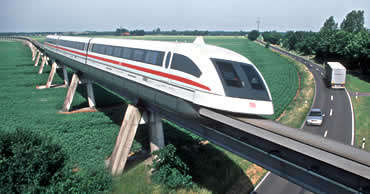
And, because this is so long, I'll reward you with a picture... an 500KM/H train that rides on magnets. These are currently running in China FYI

Magnetic

A great start!

These little H2 trucks are great! Used in airports and other large sites, these are a great way to test and promote hydrogen energy sources. Get yourself a few of these, an electrolyzer (creates hydrogen from water... have you been paying attention) and you have a low-cost replacement for electric or diesel-powered vehicles.

http://www.fuelcellsworks.com/Supppage5380.html

"The hydrogen for all the installations is supplied by an electrolyser in a central location from renewable energy. As the refuelling solution is an EU Certified product and the employees do not have to handle the hydrogen itself. The innovative metal hydride canister design and unique filling station means the training required is minimal and operation simple."

And they're using the hydride storage which is awesome! Metal hydrides are the safest way to store hydrogen but they have not quite been perfected yet. Using them in real-world applications on a constant basis is an excellent way to test and perfect them.